



Table of Contents Show
Wearable technology was supposed to change everything. That was the promise. Smartwatches would replace phones. Fitness trackers would transform global health. Augmented reality glasses would redefine how we see the world. Smart clothing would monitor our bodies in real time. Analysts predicted exponential growth. Investors poured in billions. Tech giants competed aggressively. And yet, here we are.
The question that keeps surfacing is uncomfortable but necessary: are wearables a market failure?
This is not a simple yes-or-no debate. It requires examining adoption patterns, consumer behavior, technological limitations, economics, psychology, and even sociology. Some segments of wearables are thriving. Others have stalled or quietly disappeared. Some products are indispensable to certain users but irrelevant to the mass market. The story is more nuanced than either the hype or the cynicism would suggest.
To answer the question properly, we need to explore what was promised, what was delivered, what consumers actually value, and where the market stands today.
Understanding What “Wearables” Really Means
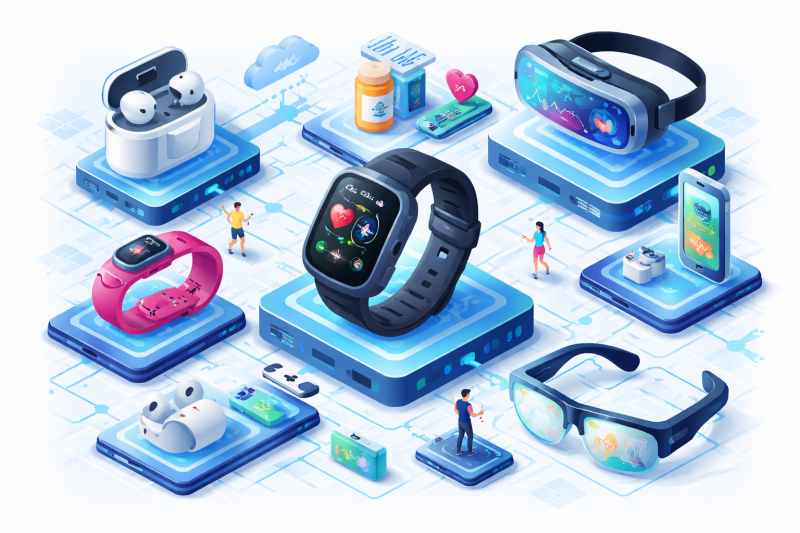
The term wearable technology is broad. It includes everything from fitness trackers to smart glasses to medical devices embedded in clothing. The idea is simple: computing devices worn on the body that collect data, provide feedback, or extend digital functionality beyond traditional screens.
Early pioneers like Fitbit helped popularize the category by turning step counting into a cultural phenomenon. Then came the Apple Watch, which expanded the concept beyond fitness into communication, notifications, and health monitoring. More recently, products such as Meta Quest and Google Glass pushed the boundaries into augmented and virtual reality.
On paper, the category looks strong. According to market data compiled by sources such as International Data Corporation, wearable shipments have remained substantial over the past decade, especially in the smartwatch and hearables categories. Wikipedia’s overview of wearable technology provides a useful starting point for understanding its evolution and segmentation: https://en.wikipedia.org/wiki/Wearable_technology.
However, headline shipment numbers do not necessarily equal transformative impact. That is where the tension lies.
The Hype Cycle Problem
Every emerging technology passes through a hype cycle. There is an innovation trigger, followed by inflated expectations, disillusionment, and eventually a plateau of productivity. Wearables followed this pattern almost perfectly.
In the early 2010s, wearables were marketed as the next smartphone. Analysts speculated that smartphones would become secondary devices, with smart glasses or watches taking over as primary interfaces. That never happened.
Instead, most wearables became companions to smartphones rather than replacements. The smartwatch mirrors notifications. The fitness tracker syncs to an app. The AR headset still relies heavily on an ecosystem anchored by other devices.
This dependency matters. When a category cannot stand alone, it often struggles to justify its existence beyond incremental convenience.
Adoption Versus Retention
One of the strongest arguments for calling wearables a market failure comes from retention rates rather than adoption numbers.
Millions of fitness trackers were sold in the mid-2010s. But studies showed that a significant percentage of users abandoned them within months. A widely cited survey discussed in academic health research and summarized in public resources found that many users stop using fitness trackers after the novelty wears off.
This is not uncommon in behavior-change tools. The device provides data, but data alone does not guarantee long-term motivation. People know they should exercise. Seeing their step count does not necessarily change that behavior sustainably.
Here is a simplified view of the adoption-retention gap:
| Metric | High Adoption | Long-Term Retention |
|---|---|---|
| Fitness Trackers | Yes | Often Low |
| Smartwatches | Yes | Moderate |
| AR Glasses | Limited | Unclear |
| Medical Wearables | Growing | High (when clinically necessary) |
The difference often comes down to perceived value. If a wearable solves a problem that feels urgent or meaningful, users keep it. If it feels optional, it fades.
Health: The Strongest Justification
The strongest argument against the “market failure” thesis lies in health applications.
Wearables have evolved far beyond step counting. Modern smartwatches can detect irregular heart rhythms, monitor blood oxygen levels, and track sleep patterns. Some features have regulatory approval in certain markets for health-related monitoring.
For example, atrial fibrillation detection features have been studied extensively. Research referenced in public summaries, including on Wikipedia’s page for the Apple Watch, indicates that large-scale heart monitoring through consumer devices is technically viable. You can read more about that here: https://en.wikipedia.org/wiki/Apple_Watch.
When wearables move into clinical territory, they stop being lifestyle gadgets and start becoming medical tools. Compliance rises. Retention improves. Value becomes tangible.
This suggests that wearables are not inherently flawed. They simply need to solve serious problems rather than superficial ones.
The Convenience Paradox
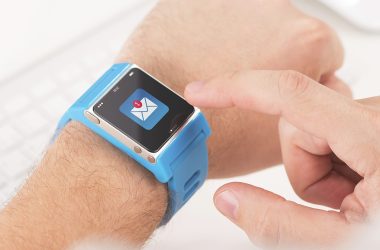
Smartwatches are arguably the most commercially successful wearable category. The Apple Watch dominates globally, and competitors from Samsung and Garmin maintain strong niches.
But here is the paradox: what problem do they fundamentally solve?
They reduce the friction of checking notifications. They allow quick replies. They provide fitness tracking. They act as payment devices. All useful. None essential.
The smartphone remains the primary device. The wearable is additive.
This matters economically. For a market to be transformative rather than incremental, it typically replaces something or creates a new category of indispensable behavior. Smartphones replaced feature phones and absorbed cameras, MP3 players, GPS units, and more. Wearables have not displaced anything major.
They have layered on top.
Augmented Reality: A Missed Moment?
If wearables were going to redefine computing, augmented reality glasses were the strongest candidate. Google Glass was perhaps the boldest early attempt. It failed commercially and culturally, partly due to privacy concerns and partly due to unclear consumer value.
Later attempts have been more refined, but mass adoption remains elusive. Even advanced mixed-reality devices face challenges: cost, comfort, battery life, and social acceptance.
Wearing conspicuous technology on your face changes social dynamics. Unlike phones, which can be discreetly pocketed, face-worn devices alter interpersonal perception. That psychological barrier is substantial.
A technology can be technically brilliant and still fail socially.
Battery Life and Form Factor Constraints
Wearables face fundamental physical limitations. They must be small, lightweight, comfortable, and durable. That constrains battery capacity. Limited battery life reduces functionality or requires frequent charging. Frequent charging reduces convenience.
This engineering trade-off is not trivial. It caps how powerful wearables can become without compromising usability.
Consider this simplified trade-off table:
| Factor | Increase Functionality | Increase Comfort | Increase Battery |
|---|---|---|---|
| Device Size | Must Increase | Must Decrease | Must Increase |
| Weight | Increases | Decreases | Increases |
| Heat | Increases | Decreases | Increases |
You cannot maximize all three simultaneously. Wearables live inside those constraints permanently.
The Data Privacy Question
Another issue slowing enthusiasm is data privacy. Wearables collect intimate biological data: heart rate, sleep patterns, stress levels, movement patterns, even potentially mood proxies.
Consumers are increasingly aware of digital privacy risks. News cycles regularly highlight data breaches and surveillance concerns. When devices sit on your wrist 24 hours a day collecting physiological data, trust becomes critical.
Trust is fragile. If consumers feel that their biometric data might be exploited, adoption hesitates.
The Market Is Not Collapsing
Despite these criticisms, calling wearables a complete market failure would be inaccurate. The category generates billions annually. Certain segments, especially hearables (wireless earbuds), have exploded in popularity.
Products like AirPods have arguably become more culturally embedded than smartwatches. But are earbuds truly wearables in the transformative sense, or simply wireless audio accessories? That distinction matters.
The line between accessory and revolution is thin.
Who Actually Uses Wearables Long Term?
The strongest long-term users of wearables tend to fall into specific categories:
- Fitness enthusiasts and athletes who value detailed metrics.
- Individuals with health conditions requiring monitoring.
- Professionals in specialized environments.
- Technology enthusiasts who enjoy early adoption.
The mainstream, casual user often disengages after initial excitement fades.
This suggests that wearables may be a niche success rather than a universal one.
Network Effects and Ecosystem Lock-In
One reason the Apple Watch succeeds where others struggle is ecosystem integration. It integrates seamlessly with iPhones, Apple Fitness, Apple Pay, and Apple Health.
Wearables benefit significantly from platform lock-in. That raises an interesting economic question: is the wearable successful because it is compelling on its own, or because it strengthens an existing ecosystem?
If a product’s success depends heavily on ecosystem reinforcement, its standalone value may be limited.
Comparing Wearables to Smartphones
Let us compare wearables to smartphones at similar maturity stages.
| Category | Years to Mass Adoption | Replacement Effect | Daily Dependency |
|---|---|---|---|
| Smartphones | Rapid (2007–2012) | Replaced multiple devices | High |
| Wearables | Gradual (2014–Present) | Rarely replace devices | Moderate |
Smartphones became unavoidable within five years. Wearables have not achieved that inevitability after more than a decade.
That signals something important.
Behavioral Change Is Hard
Many wearables promise behavior change: more exercise, better sleep, reduced stress. But behavioral science shows that awareness does not automatically produce sustained action. Habit formation requires more than data dashboards.
If a product’s core promise depends on sustained self-discipline from the user, it faces structural friction.
Data without deep integration into human psychology often fades into background noise.
So, Are Wearables a Market Failure?
The honest answer is this: they are not a catastrophic failure, but they have not fulfilled their transformative promise.
They have succeeded as accessories. They have struggled as paradigm shifts.
Health-oriented wearables show genuine potential. Specialized use cases demonstrate clear value. Ecosystem-aligned devices perform strongly. But the grand vision of wearables replacing phones and redefining computing remains unrealized.
The Future: Incremental or Breakthrough?
The future of wearables likely hinges on three breakthroughs:
- Battery technology that significantly extends lifespan without increasing size.
- AI integration that provides genuinely proactive assistance rather than passive metrics.
- Socially acceptable augmented reality that feels natural rather than intrusive.
If those align, wearables could re-enter a growth renaissance. If not, they may remain in the realm of useful but non-essential companions.
Conclusion
Wearables are not a market failure in financial terms. They are a market disappointment relative to early expectations.
They succeeded commercially in segments. They failed to redefine computing. They proved that convenience sells, but transformation requires deeper utility.
The real lesson is not that wearables failed. It is that hype overshot human behavior. Technology can be powerful. But unless it aligns with real, sustained human needs, it plateaus. Wearables today sit at that plateau.
Whether they climb higher depends not just on better hardware, but on better alignment with how people actually live.