




Table of Contents Show
If you’re even remotely serious about retro gaming in 2026, you’ve heard the name “MiSTer.” Maybe you’ve also heard the phrase “MiSTer Multisystem” whispered in forums like some kind of holy grail. And maybe, like a lot of people, you’re wondering whether this thing really is the ultimate retro rig, or just another expensive rabbit hole for people who can’t let go of their childhood.
Let’s be blunt. The MiSTer ecosystem is not for the casual nostalgia tourist. It is not plug-and-play in the same way a mini console is. It is not as simple as downloading an emulator and firing up a ROM. But if what you want is authenticity, accuracy, and a level of hardware faithfulness that software emulation simply cannot always match, then the MiSTer Multisystem might just be the best retro gaming platform available today.
To understand whether it deserves the title “ultimate retro rig,” we need to break down what it is, how it works, what makes it different, and where it falls short.
What Is the MiSTer Project?
At its core, MiSTer is an open-source project built around FPGA technology. FPGA stands for Field-Programmable Gate Array, which is essentially a reconfigurable chip that can be programmed to replicate the hardware logic of classic consoles and computers at a low level.
Unlike traditional emulation, which uses software to simulate the behaviour of a system, FPGA-based systems attempt to recreate the original hardware logic itself. That means instead of pretending to be a Nintendo Entertainment System, you are effectively building a digital version of the hardware circuitry inside it.
The MiSTer platform is built primarily around the Terasic DE10-Nano development board and a set of add-ons. It supports cores that replicate dozens of classic systems, including the:
- Nintendo Entertainment System
- Super Nintendo Entertainment System
- Sega Mega Drive
- Neo Geo
- Commodore 64
- Amiga 500
If you want a deeper overview of FPGA and how it differs from traditional emulation, Wikipedia provides a good technical starting point:
https://en.wikipedia.org/wiki/Field-programmable_gate_array
And if you want a broader overview of the MiSTer platform itself, see:
https://en.wikipedia.org/wiki/MiSTer
But reading about it doesn’t quite capture what makes it special.
Enter the MiSTer Multisystem
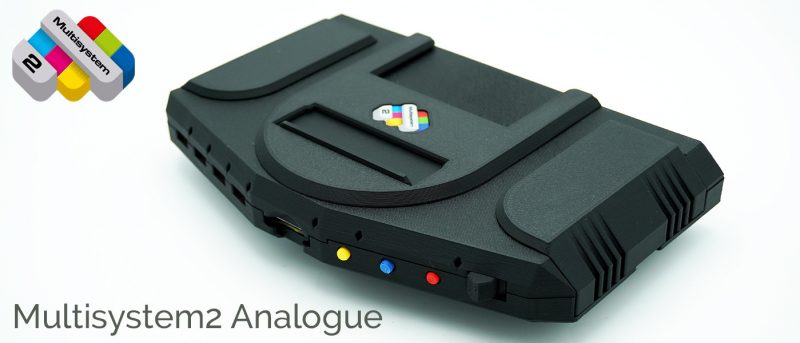
The MiSTer Multisystem is a purpose-built case and integrated solution designed to turn the MiSTer from a stack of boards and cables into something that looks and feels like a finished consumer console.
Instead of a pile of exposed PCBs and ribbon cables, the Multisystem offers:
- A professionally designed enclosure
- Integrated I/O board
- Built-in power solution
- USB hub
- Real controller ports (including DB9)
- Cartridge slots (in some configurations)
In other words, it takes what was previously a hobbyist build and turns it into something that can sit proudly under your TV.
That matters more than you think. Retro gaming is not just about accuracy. It is about experience. It is about tactile feel. It is about plugging in a proper controller, hearing the click of a power switch, and not feeling like you’re running a science experiment.
FPGA vs Software Emulation: Why It Matters
Let’s cut through the hype.
Software emulation has improved massively. Projects like RetroArch and standalone emulators do an incredible job. On a powerful PC, many systems run beautifully, with shaders and enhancements that look stunning.
So why bother with FPGA?
Here’s the difference in simple terms:
Software emulation translates instructions from the original system into instructions your modern CPU understands. FPGA recreates the hardware logic directly.
That means:
- Cycle-accurate timing
- Hardware-level behaviour replication
- Fewer edge-case glitches
- Better compatibility with obscure or timing-sensitive titles
For casual players, the difference might be invisible. For enthusiasts, speedrunners, and purists, it absolutely is not.
For example, certain titles on the Super Nintendo Entertainment System rely on extremely precise timing behaviour. Software emulators can approximate this very well, but FPGA cores can replicate the original logic gates and timing patterns in a way that is fundamentally closer to the real hardware.
That is the core selling point.
What Systems Does It Support?
The MiSTer ecosystem supports dozens of cores, including consoles, arcade boards, and home computers. The Multisystem itself is hardware-agnostic; it runs whatever the MiSTer supports.
Here’s a simplified table of categories:
| Category | Examples |
|---|---|
| 8-bit Consoles | NES, Master System, PC Engine |
| 16-bit Consoles | SNES, Mega Drive, Neo Geo |
| Arcade Systems | CPS-1, CPS-2, various 80s and 90s boards |
| Home Computers | Commodore 64, Amiga 500, Atari ST |
| Handhelds | Game Boy, Game Boy Advance |
The real magic lies in the arcade cores. Playing a CPS-2 arcade title through FPGA on a CRT feels remarkably close to the original cabinet.
The Experience on a CRT
This is where MiSTer goes from “interesting” to “obsessive hobby.”
The MiSTer Multisystem supports analog video output, including RGB and component. If you connect it to a proper CRT television, the experience becomes startlingly authentic.
Scanlines are not simulated. They are physically present because the display itself generates them.
Latency is effectively identical to original hardware.
For anyone who grew up in the 80s and 90s, this is the closest thing to time travel short of tracking down pristine original hardware.
And unlike aging consoles, the MiSTer does not suffer from failing capacitors, yellowing plastic, or dying optical drives.
Build Quality and Design
The Multisystem was created to solve a real problem: MiSTer builds looked messy. You had stacked boards, ribbon cables, exposed ports, and 3D printed cases of wildly varying quality.
The Multisystem turns that into something cohesive and professional.
It includes:
- Clean front-facing controller ports
- Solid enclosure
- Integrated USB
- Clean power delivery
- Support for SNAC (for original controllers with low latency)
This makes it far more approachable for people who do not want to assemble and troubleshoot individual components.
That said, it is still not as simple as buying a retail console. There is still setup. There are still cores to update. You will still spend time on forums.
If that annoys you, this is not your device.
Cost: Let’s Be Honest
Here’s where the “ultimate” label becomes controversial.
A full MiSTer setup typically includes:
- DE10-Nano board
- RAM expansion
- I/O board
- USB hub
- Case (Multisystem)
- Power supply
- Storage
You are looking at several hundred dollars at minimum.
Compared to a Raspberry Pi or even a second-hand console with a flash cart, that is expensive.
However, compare it to collecting original hardware across 15+ systems, maintaining them, sourcing cables, and repairing aging units, and suddenly the MiSTer starts to look like a consolidation device.
It is not cheap. But it is arguably efficient.
Accuracy vs Enhancement
Here is a key philosophical question.
Do you want original accuracy, or do you want modern enhancements?
MiSTer prioritises accuracy. It does not focus on:
- HD texture packs
- Wide-screen hacks
- Frame interpolation
- Massive shader stacks
If you want modern reinterpretations of retro games, a PC emulator will offer more flexibility.
MiSTer is about preservation.
It is about recreating how the hardware actually functioned, not how we wish it had.
For purists, this is exactly the point.
Community and Longevity
The MiSTer project thrives because of its community. Developers continually improve cores, fix timing issues, and add systems.
This is not a corporate product cycle. It is an enthusiast-driven ecosystem.
That is a strength and a weakness.
Strength: rapid innovation and passion-driven accuracy.
Weakness: no formal warranty of future support.
But given its growth and the maturity of many cores, it is not going anywhere soon.
Is It Better Than Original Hardware?
This is the question people hesitate to answer.
In many cases, yes.
Original hardware suffers from:
- Aging capacitors
- Inconsistent video output
- Dying disk drives
- Scarce replacement parts
MiSTer replicates the logic without the decay.
However, collectors may argue that nothing replaces holding the original Sega Mega Drive or sliding a cartridge into a Nintendo Entertainment System.
Emotionally, they are right.
Technically, MiSTer often wins.
Who Is It For?
Let’s simplify this.
The MiSTer Multisystem is ideal for:
- Retro purists
- CRT enthusiasts
- Arcade accuracy fans
- Speedrunners
- Hardware nerds
It is not ideal for:
- Casual nostalgia gamers
- People who want plug-and-play simplicity
- Gamers who prefer HD remasters
- People who dislike tinkering
Where It Falls Short
No system is perfect.
Limitations include:
- Ongoing cost and component sourcing
- Occasional core limitations
- Setup complexity
- Limited official support structure
- Not every system under the sun is supported
Also, FPGA resources are finite. The DE10-Nano has limits. Some more complex systems push against those boundaries.
There are ongoing discussions about next-generation FPGA boards that could expand capabilities further.
So, Is It the Ultimate Retro Rig?
If your definition of “ultimate” is authenticity, hardware accuracy, and multi-system consolidation in a beautifully designed enclosure, then yes, the MiSTer Multisystem makes an extremely strong case.
If your definition of ultimate is ease, convenience, and high-resolution enhancements, then no, a modern PC setup probably wins.
It comes down to philosophy.
MiSTer is preservation-first.
And in an age where software licensing disappears and physical media decays, preservation matters.
FAQ
What is the difference between MiSTer and normal emulation?
MiSTer uses FPGA hardware to replicate original system logic, while normal emulation uses software running on a CPU to simulate the system.
Is the MiSTer Multisystem beginner-friendly?
It is more beginner-friendly than a DIY MiSTer stack, but it still requires some technical comfort.
Does it support HDMI?
Yes, HDMI output is supported, along with analog video options for CRT displays.
Can I use original controllers?
Yes, especially with SNAC adapters or built-in controller ports on the Multisystem.
Is it cheaper than collecting original consoles?
For multiple systems, often yes. For just one system, probably not.
Does it support PlayStation or N64?
Support for more complex 3D systems is limited due to FPGA constraints.
Is it legal?
The hardware itself is legal. Game ROM usage depends on ownership and local law.
Is it future-proof?
As long as the community continues development and FPGA hardware remains available, it has strong longevity.
Does it replace original hardware completely?
Technically, in many cases yes. Emotionally, that is subjective.
Is it worth it?
If you care deeply about hardware accuracy and preservation, absolutely. If you just want to replay a few childhood games casually, there are cheaper and simpler options.
The MiSTer Multisystem is not mainstream. It is not flashy. It is not designed to impress people who want 4K ray-traced nostalgia. It is built for people who want to preserve the past as faithfully as possible.
And for that audience, it may well be the ultimate retro rig.