




Table of Contents Show
If you only skim headlines, it feels like the games industry is thriving. Budgets are bigger than ever. Studios employ hundreds, sometimes thousands, of developers. Marketing campaigns rival Hollywood blockbusters. And yet, beneath the surface, something is clearly broken. For every smash hit, there are multiple AAA games that underperform, disappoint, or outright flop.
Like Concord.
This isn’t about indie charm beating corporate polish. It’s about why projects with enormous budgets, world-class talent, and years of development still end up feeling hollow, buggy, or instantly forgettable. Players sense it. Publishers feel it. Developers live it.
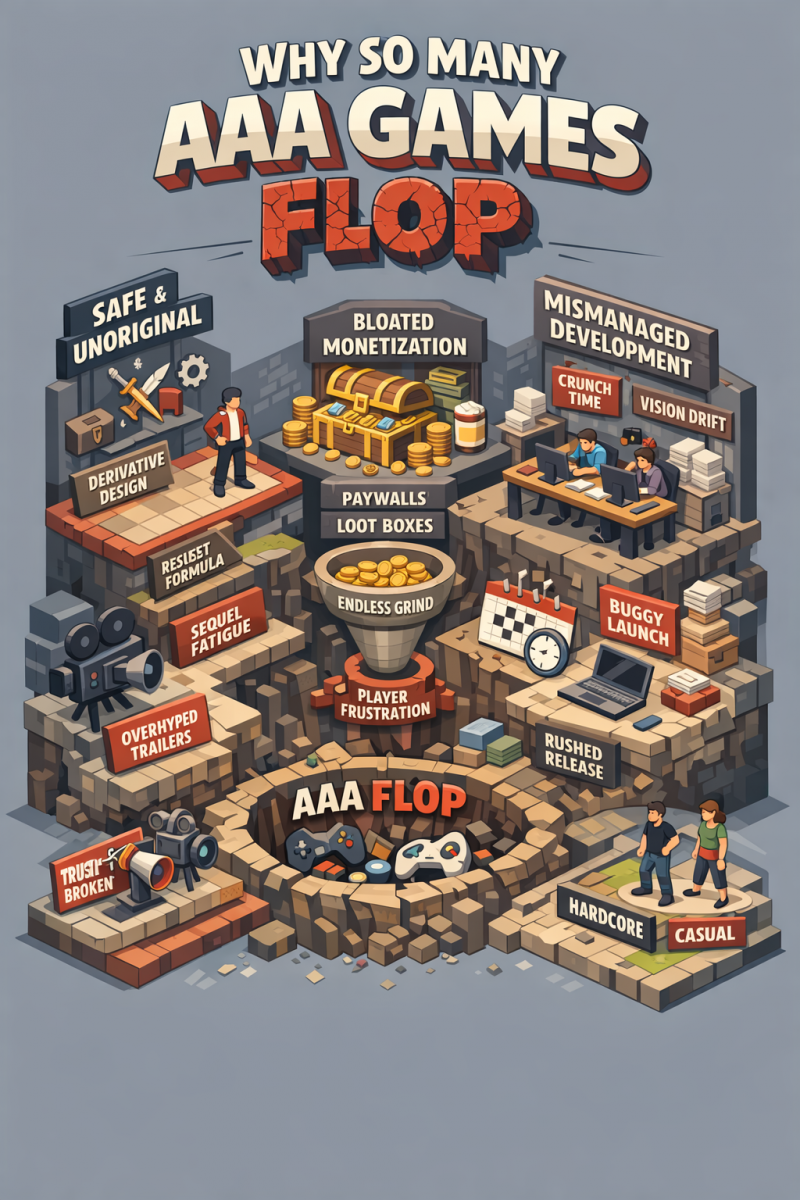
AAA games aren’t failing because gamers are “too demanding” or because social media is toxic. They’re failing because of structural, cultural, and creative problems baked deep into how modern AAA games are conceived, funded, and shipped.
Let’s break it down properly.
What “AAA” Actually Means Today
AAA used to mean something simple: high production value, technical ambition, and a sense that you were playing a premium experience. Today, it mostly means high cost and high risk.
Modern AAA games often involve:
- Budgets exceeding $100–300 million
- Development cycles of five to eight years
- Massive cross-studio collaboration across countries
- Shareholder expectations baked into design decisions
- Monetisation plans locked in before gameplay is final
This scale doesn’t just increase quality. It changes incentives. When a project costs that much, it becomes less about making a great game and more about avoiding financial disaster.
That single shift explains more flops than any individual technical mistake ever could.
The Fear of Risk Has Killed Originality
Safe Design Is the Default
When hundreds of millions are on the line, creativity becomes dangerous. Instead of asking “What would be fun?”, studios ask “What worked last time?”
The result is a flood of games that feel eerily familiar. Another open world. Another crafting system. Another skill tree bloated with percentage boosts. Another “cinematic” story that wrestles control away from the player every ten minutes.
Risk aversion doesn’t produce terrible games. It produces bland ones. And bland games flop quietly, not because they’re broken, but because no one cares enough to keep playing.
Innovation Gets Sanded Down
Most AAA projects start with interesting ideas. Over time, those ideas get diluted by committee feedback, market research, and executive sign-off.
Features that feel unusual are flagged as “confusing.”
Mechanics that challenge players are labelled “friction.”
Narrative risks are softened to avoid controversy.
What survives is the most inoffensive version of the original vision. Technically impressive, emotionally flat.
Games Designed by Committee Rarely Feel Alive
Too Many Stakeholders, Not Enough Ownership
In large studios, no single person truly owns the game. Creative directors answer to publishers. Designers answer to metrics. Writers answer to brand guidelines.
Decisions get filtered through layers of approval, and each layer strips away clarity. By the time a feature ships, it exists because no one objected strongly enough to remove it, not because anyone believed in it deeply.
Great games usually have a strong creative spine. Many AAA games feel like a spreadsheet of compromises.
Vision Drift Over Long Development Cycles
Five to eight years is an eternity in entertainment. Trends change. Engines evolve. Player expectations shift.
AAA projects often begin chasing one market reality and ship into a completely different one. Instead of re-thinking the core, teams bolt on new ideas mid-development: live-service hooks, multiplayer modes, battle passes.
The end result feels disjointed. Players can sense when a game doesn’t know what it wants to be.
Monetisation Warps Game Design
The Tail Is Wagging the Dog
In many AAA projects, monetisation isn’t an afterthought. It’s a foundational pillar. Progression systems, pacing, and even difficulty are shaped to support future spending.
That creates subtle but powerful problems:
- Progress feels artificially slow
- Rewards feel hollow or delayed
- Systems exist to funnel players, not entertain them
Players may not consciously analyse this, but they feel it. When engagement is engineered rather than earned, trust erodes quickly.
Live-Service Expectations Hurt Single-Player Games
Even games that aren’t full live services are often designed like they might become one. This leads to bloated systems, grindy mechanics, and an obsession with “retention.”
Not every game needs to last forever. Some of the most beloved games are tight, focused experiences. AAA studios often forget that finishing a great game is better than abandoning a mediocre one after ten hours.
Technology Often Outpaces Design
Chasing Graphics Over Gameplay
AAA studios excel at visual fidelity. Ray tracing, photogrammetry, facial capture, and cinematic lighting are genuinely impressive.
But graphics don’t make games fun. They make screenshots impressive.
Many flops look incredible in trailers but feel empty once you start playing. When technology leads and design follows, the experience becomes shallow. Players notice when environments exist to be admired, not interacted with.
Toolchains Are Complex and Fragile
Modern engines are powerful, but they’re also complicated. Large teams working on shared codebases introduce risk at every turn.
This leads to:
- Systems that technically work but feel clunky
- Bugs that persist because no one fully understands the entire system
- Last-minute crunch trying to stabilise features that should have been cut
When players encounter rough edges, immersion breaks instantly, no matter how good the lighting looks.
Crunch Culture Burns Out Talent
Burnout Shows in the Final Product
AAA development often relies on prolonged crunch. Long hours, tight deadlines, and constant pressure are normalised.
Burnt-out developers don’t produce their best work. They produce what they can survive delivering.
You see it in:
- Repetitive mission design
- Unpolished systems
- Features that feel half-finished
This isn’t about laziness or lack of skill. It’s about exhaustion.
Talent Drain Is Real
Many experienced developers leave AAA studios after a few brutal cycles. They move to indie teams, tech companies, or entirely different industries.
That means AAA studios frequently rely on less experienced staff to maintain incredibly complex systems. Knowledge loss compounds over time, making each project harder than the last.
Marketing Hype Sets Impossible Expectations
Trailers Promise a Different Game
AAA marketing often begins years before launch. Vertical slices, scripted demos, and cinematic trailers create expectations that the actual game cannot meet.
When players feel misled, backlash is immediate and unforgiving. Even a decent game can flop if it’s not the game people thought they were buying.
Pre-Orders Reduce Accountability
Heavy pre-order campaigns lock in revenue before reviews or player feedback exist. That can reduce pressure to polish or refine late in development.
Players are becoming more cautious, but the damage is already done. Once trust is broken, studios struggle to recover, even with future releases.
Audience Fragmentation Makes Mass Appeal Harder
There Is No “Average Gamer” Anymore
The gaming audience is huge and diverse. Designing a single game to confirm to everyone is nearly impossible.
AAA studios often try anyway, resulting in games that are:
- Too shallow for hardcore fans
- Too complex for casual players
- Too long for story-focused players
Trying to please everyone usually pleases no one.
Communities Spot Weakness Instantly
Social platforms amplify feedback at unprecedented speed. Bugs, design flaws, and narrative missteps are dissected within hours of release.
This isn’t inherently bad, but it leaves little room for slow-burn appreciation. A shaky launch can permanently damage perception, even if the game improves later.
Sequels Suffer From Creative Exhaustion
Franchises Get Stretched Too Far
Successful IPs are milked because they feel safer than new ideas. Over time, teams struggle to justify why the next entry exists at all.
When sequels add features without re-thinking fundamentals, the result is bloat. More systems, more content, less cohesion.
Players sense when a franchise has lost its reason for being.
Nostalgia Is a Weak Substitute for Vision
Remakes, remasters, and reboots rely heavily on nostalgia. That can work, but only when paired with respect and understanding.
When nostalgia is used as a shortcut rather than a foundation, fans feel exploited. The backlash can be severe and long-lasting.
Project Management Breaks at Scale
Coordination Costs Are Enormous
Hundreds of developers across multiple studios require extraordinary coordination. Miscommunication is inevitable.
Small design changes ripple outward, causing delays and rework. By the time issues are identified, they’re often too expensive to fix properly.
Deadlines Trump Quality
Release windows are often dictated by fiscal years, shareholder calls, or marketing commitments. When deadlines collide with reality, quality loses.
Games ship unfinished, relying on patches to fix fundamental issues. Players may forgive small bugs. They don’t forgive broken promises.
The Emotional Disconnect Is Real
Games Feel Manufactured, Not Crafted
Players don’t just want content. They want connection. They want to feel that someone cared deeply about what they made.
Many AAA games feel polished but soulless. Everything works, yet nothing resonates. That emotional flatness is deadly in a medium built on immersion.
Passion Is Hard to Scale
Small teams can pour personality into every corner. Large teams struggle to maintain a shared emotional vision.
Without strong leadership and clear values, projects default to technical competence rather than creative soul.
Why Some AAA Games Still Succeed
Not all AAA games flop. The ones that succeed tend to share a few traits:
- Clear creative vision from start to finish
- Willingness to take controlled risks
- Respect for player time and intelligence
- Focus on core experience over monetisation gimmicks
These successes prove the model isn’t impossible. It’s just incredibly hard to execute well.
The Industry Is at a Crossroads
AAA development is unsustainable in its current form. Budgets are ballooning while player patience is shrinking. Studios can’t keep doubling down on size while hoping quality emerges naturally.
Something has to give.
That might mean:
- Smaller, more focused AAA experiences
- Longer gaps between sequels
- Greater creative autonomy for teams
- Less obsession with infinite engagement
The future of AAA gaming won’t be decided by technology alone. It will be decided by whether studios remember why people play games in the first place.
Final Thoughts
AAA games don’t flop because developers are incompetent or because players are ungrateful. They flop because the system that produces them prioritises safety, scale, and revenue over creativity, coherence, and care.
Players can forgive flaws. They can’t forgive indifference.
Until AAA studios realign incentives around making genuinely great experiences, flops will continue to be the norm rather than the exception.