



Table of Contents Show
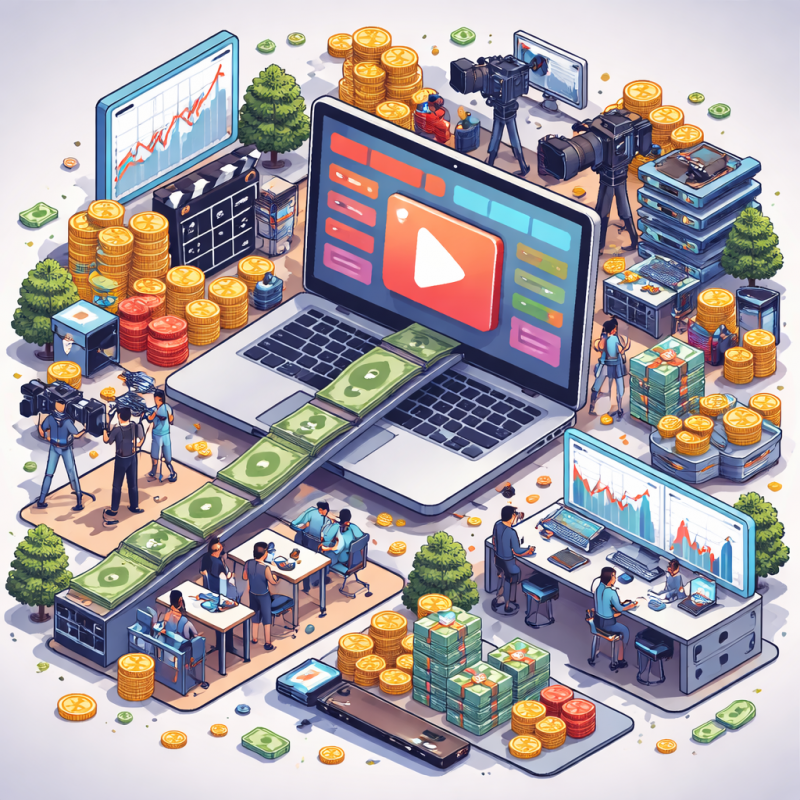
Streaming looks effortless from the outside. You click a button, and within seconds a film, a series, or a song begins to play. No physical media, no waiting, no visible friction. It feels like abundance at almost zero cost. That illusion of simplicity hides one of the most brutally competitive and capital-intensive industries of the last decade.
Streaming platforms have rewritten how we consume media, but they have also rewritten the economics of media production. The old rules of television, cinema, and music distribution are gone. In their place is a high-stakes, global, algorithm-driven arms race where scale is everything, profitability is elusive, and churn is a constant threat.
To understand the brutality of streaming economics, we need to look at four forces simultaneously: capital expenditure, subscriber growth pressure, content arms races, and razor-thin margins. Once you see how these interact, the fairy tale of “cheap unlimited entertainment” becomes something much harder.
The Illusion of Cheap Entertainment
When Netflix launched its streaming service in 2007, it looked like magic. Consumers were paying a modest monthly subscription for on-demand access to a growing library. Compared to cable bundles that could cost £50–£100 per month, streaming felt like a bargain.
But here is the uncomfortable truth: streaming was underpriced for years.
For most of the 2010s, companies prioritised growth over profit. The goal was simple: acquire as many subscribers as possible, in as many markets as possible, as fast as possible. Losses were acceptable because investors believed scale would eventually produce dominance and pricing power.
This strategy was not unique to streaming. It mirrors the venture-backed “blitzscaling” model popularised in Silicon Valley. However, unlike software platforms with low marginal costs, streaming has extraordinarily high ongoing costs.
- Every new subscriber increases delivery costs.
- Every new region requires licensing negotiations.
- Every new original show requires tens or hundreds of millions in capital.
That is not a lightweight business model. That is a heavyweight industrial machine disguised as an app.
The Content Arms Race
The core economic engine of streaming is content. Without exclusive shows and films, subscribers leave. That means platforms must constantly feed an insatiable audience.
Consider the annual content spending figures of major players at their peak expansion phases:
| Platform | Approx. Annual Content Spend (Peak Growth Era) |
|---|---|
| Netflix | $17–18 billion |
| Disney (Disney+) | $25+ billion (across divisions) |
| Amazon (Prime Video) | $15+ billion |
| Warner Bros. Discovery | $20+ billion |
These are not small numbers. These are numbers that rival the GDP of small nations.
The logic is brutal: if you do not produce hit shows, you lose subscribers. If you lose subscribers, your share price drops. If your share price drops, capital becomes more expensive. And if capital becomes more expensive, your content budget becomes harder to sustain.
This creates a self-reinforcing pressure cycle. And here is the kicker: most shows fail.
A handful of breakout successes like “Stranger Things” or major franchise spin-offs drive disproportionate engagement. The majority of productions quietly underperform. Yet the cost structure does not care about averages. It cares about total spending.
Why Libraries Are Not Enough
In the early days, streaming platforms relied heavily on licensed back catalogues. Classic sitcoms, syndicated dramas, and existing film libraries provided enormous value. That era is over.
As media conglomerates realised the long-term value of streaming, they pulled their content back to launch their own services. Disney launched Disney+. Warner Bros. Discovery consolidated assets into Max. Paramount Global pushed Paramount+.
This fragmentation destroyed the single-platform utopia. Consumers now face subscription stacking: Netflix, Disney+, Prime Video, Apple TV+, and more. The monthly cost creeps back toward cable territory.
The economics shifted from licensing arbitrage to original production dependency. And original production is expensive. A flagship series can cost $10–$25 million per episode. A fantasy epic can exceed $50 million per episode. For a 10-episode season, that is half a billion dollars.
To put that into perspective, here is a simple comparison:
| Content Type | Approximate Cost |
|---|---|
| Mid-tier drama episode | $5–8 million |
| High-end prestige drama | $15–20 million |
| Blockbuster fantasy series | $40–60 million |
| Major theatrical film | $150–300 million |
The financial risk is staggering.
Subscriber Growth vs. Saturation
For over a decade, Wall Street rewarded subscriber growth above all else. Every quarterly earnings call focused on net additions. But growth slows. It always does. In mature markets like the US and UK, streaming penetration is already high. There are only so many households. Once you approach saturation, the game shifts from acquisition to retention. Retention is harder.
- A user can cancel with one click.
- There is no contract.
- There is no installation barrier.
This is the churn problem. Churn measures how many subscribers cancel each month. Even a small percentage change can dramatically impact revenue forecasts.
Let’s look at simplified economics:
| Metric | Example Scenario |
|---|---|
| Subscribers | 200 million |
| Monthly fee | $12 |
| Monthly revenue | $2.4 billion |
| Annual revenue | $28.8 billion |
Now assume 3% monthly churn. That means 6 million subscribers leaving each month. The platform must replace them just to stand still.
Churn forces constant marketing spend and content investment. It is not optional.
Advertising: The Pivot Back to What We Abandoned
Ironically, streaming is drifting back toward advertising models. Platforms once positioned themselves as ad-free alternatives to cable. Now they are reintroducing ads through lower-tier subscriptions. Why? Because pure subscription economics are fragile. Advertising diversifies revenue. It also increases average revenue per user (ARPU) without raising subscription prices directly.
According to research discussed on Wikipedia’s overview of the streaming business model, platforms increasingly rely on hybrid monetisation structures combining subscription and advertising revenue to stabilise cash flow (see: https://en.wikipedia.org/wiki/Subscription_business_model).
The move toward ad-supported tiers is not a betrayal of principle. It is economic necessity. (But will it backfire in even more growth of piracy? Check out our post on the Kodi revival.)
Debt and Capital Pressure
One of the most under-discussed aspects of streaming economics is debt. To finance content expansion, companies borrowed heavily. During the low-interest-rate era of the 2010s, debt was cheap. That made aggressive spending rational.
When interest rates rose globally in the early 2020s, the equation changed. Servicing debt became more expensive. Investors demanded profitability, not just growth. Suddenly, cost-cutting began.
Projects were cancelled.
Shows were removed from libraries.
Staff were laid off.
The shift was visible across the industry. Netflix began emphasising free cash flow. Warner Bros. Discovery aggressively wrote down content for tax efficiency. The golden era of “spend now, profit later” ended.
The Global Expansion Gamble
Streaming is global by design. But global expansion is not simple.
Each territory requires:
- Licensing negotiations.
- Local compliance with regulations.
- Localised content.
- Payment infrastructure.
- Marketing adaptation.
In some regions, average income is lower. That constrains pricing. A subscription that costs $15 in the US may need to cost $4–$7 in emerging markets. Margins shrink.
At the same time, local competitors emerge. In India, Southeast Asia, and parts of Africa, regional platforms often undercut global players.
Global scale is powerful, but it does not eliminate regional economics.
The Algorithm Dependency
Streaming platforms are powered by recommendation algorithms. These systems drive engagement and retention. Without them, content discovery becomes overwhelming.
Algorithms increase watch time, which reduces churn risk. However, they also create homogenisation. Platforms optimise for content that performs predictably. Risk-taking becomes financially dangerous.
This creates an economic feedback loop:
- High production cost + algorithmic optimisation = formulaic content.
- The more expensive the stakes, the less tolerance there is for experimentation.
The Music Streaming Parallel
The brutality of streaming economics is perhaps most visible in music. Platforms like Spotify operate on razor-thin margins. Royalties consume a huge portion of revenue.
Artists frequently criticise payout structures. Per-stream payouts are fractions of a penny. Yet from the platform’s perspective, licensing deals consume the majority of revenue before operational costs.
According to publicly discussed financial breakdowns referenced on https://en.wikipedia.org/wiki/Spotify, a large percentage of revenue is allocated to rights holders.
Music streaming highlights the tension between platform sustainability and creator compensation. The same tension exists in film and television, though the mechanics differ.
The Power Law Problem
Streaming revenue follows a power law distribution. A small number of titles generate most engagement.
This creates two brutal realities:
- Platforms must constantly chase the next breakout hit.
- Most content will never justify its cost.
In traditional television, syndication and long-tail revenue could amortise risk. In streaming, content lifecycles are shorter and engagement data is immediate. Underperforming shows are cancelled quickly.
Creatively, this is destabilising. Economically, it is logical.
Price Increases and Consumer Fatigue
As platforms mature, they raise prices. This is inevitable. However, consumers are increasingly sensitive to subscription fatigue. With multiple services, the combined cost can exceed traditional cable packages.
Here is a rough comparison of cumulative subscription stacking:
| Service | Monthly Cost (Example) |
|---|---|
| Netflix | £10–£17 |
| Disney+ | £8–£11 |
| Prime Video | £9 |
| Apple TV+ | £9 |
| Total | £36–£46 |
That total excludes music, gaming subscriptions, or other digital services. The more fragmented the ecosystem becomes, the more price elasticity matters.
Password Sharing and Enforcement
For years, password sharing artificially boosted engagement metrics. When platforms cracked down, it was framed as revenue protection. From a purely economic perspective, this makes sense. If 100 million households use your service but only 80 million pay, that gap is a monetisation leak. Crackdowns increased short-term cancellations but often boosted long-term revenue. This is what economic brutality looks like: sentiment takes second place to sustainability.
The Long-Term Question: Who Wins?
Not every streaming platform will survive independently. Consolidation is likely. Smaller players may be acquired or merged. The industry could evolve toward a handful of dominant platforms with hybrid revenue models: subscription, advertising, licensing, and possibly live events or gaming integration.
The economic endgame resembles other network industries: airlines, telecoms, and cloud computing. High capital costs, high barriers to entry, limited dominant players.
Conclusion
Streaming platforms are not fragile startups anymore. They are global industrial entities balancing creative ambition against financial reality.
The brutality lies in the constant tension between:
- Art and algorithm.
- Growth and profit.
- Scale and sustainability.
- Subscriber satisfaction and shareholder expectation.
From the outside, streaming feels abundant and cheap. From the inside, it is a high-stakes war of capital allocation, data optimisation, and global competition. The next decade will not be defined by explosive growth. It will be defined by consolidation, pricing discipline, advertising expansion, and ruthless cost control. The era of easy money is over. The economics were always brutal. Now they are simply visible.