



Table of Contents Show
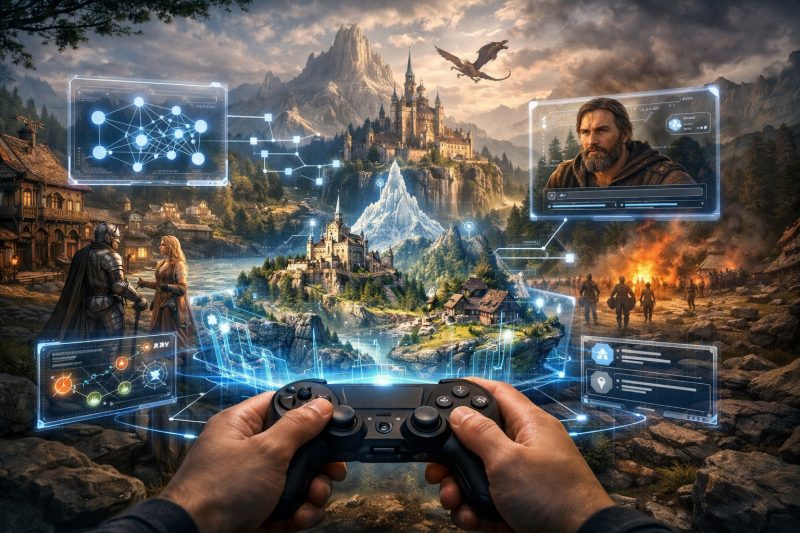
For decades, videogames have chased immersion. Better graphics. Bigger worlds. Smarter enemies. More realistic physics. Every console generation promises that this time, finally, we’ll forget we’re holding a controller. And every generation gets us closer – but never quite there. Generative AI is different. It doesn’t just polish what already exists; it changes the nature of what a game world is. Instead of a static universe painstakingly handcrafted by developers and consumed by players, we are entering an era where worlds respond, adapt, remember, and even surprise their creators. This isn’t just a technical upgrade. It’s a philosophical shift in how games are made and how they are experienced.
Current Limitations
To understand why generative AI is such a big deal, it helps to understand what’s been limiting immersion until now. Traditional game development is fundamentally finite. Every dialogue line, quest, environment, and animation has to be designed, scripted, tested, and shipped. Even the most open-world games are, under the hood, an enormous collection of predefined possibilities. You can go anywhere, but only where someone has already been. You can say many things, but only what someone has written. That’s why, after a few hours, the illusion starts to crack. NPCs repeat themselves. Side quests blur together. The world stops feeling alive and starts feeling like a very elaborate theme park.
Generative AI breaks this ceiling by introducing systems that create content on the fly. Instead of choosing from a menu of prebuilt options, the game can generate new dialogue, new characters, new environments, and even new rules in response to the player. This matters because immersion isn’t just about visual fidelity; it’s about coherence and responsiveness. A world feels real when it acknowledges your presence in a meaningful way. Generative AI makes that acknowledgement dynamic rather than scripted.
NPCs Are Alive!
One of the most immediate and obvious impacts of generative AI is on non-player characters. NPCs have always been the weak link in immersion. They look human, they sound human, but they behave like vending machines. You press the right button, they dispense the correct line. With large language models embedded into games, NPCs can hold conversations that are contextual, memory-aware, and emotionally consistent. Imagine an innkeeper who remembers that you stole from him three hours ago, subtly changes his tone, overcharges you, and warns other merchants in the area. No quest marker. No pop-up notification. Just social consequence.
This is not science fiction. Early experiments already show NPCs powered by language models capable of improvising dialogue while staying within character constraints. Unlike traditional branching dialogue trees, which explode in complexity the more choices you add, generative dialogue scales naturally. The NPC doesn’t need to know every possible sentence you might say in advance. It needs to know who it is, what it wants, and what it knows about you. From there, language emerges organically.
Memory is another key ingredient. Immersion deepens when the world remembers your actions. Generative AI allows for long-term memory systems where characters, factions, and even environments track what you’ve done and adjust accordingly. Burn down a forest to flush out an enemy, and later discover refugees displaced by your decision, telling stories about the fire you caused. Not because a designer scripted that exact scenario, but because the simulation generated consequences consistent with the world’s logic.
Procedural generation isn’t new in games, but generative AI elevates it from randomness to meaning. Early procedural worlds often felt empty or repetitive because they were driven by mathematical rules rather than narrative intent. Generative AI can blend procedural systems with narrative coherence. A village isn’t just a random cluster of buildings; it has a history, economic pressures, internal conflicts, and cultural norms that inform how it looks and how its inhabitants behave. When you arrive, you’re not just exploring space – you’re entering a story already in motion.
Unique Quests
Quests themselves are poised for a radical transformation. Today, quests are designed content. Tomorrow, they will be generated experiences. Instead of accepting a mission from a notice board, you might overhear a conversation in a tavern, infer a problem, decide to get involved, and watch the situation evolve in response to your actions. The quest doesn’t exist until you engage with it, and it doesn’t end in a predefined way. Success and failure become shades of outcome rather than binary states.
This shift has profound implications for replayability. In traditional games, replay value comes from trying different builds or making different choices within the same narrative framework. With generative AI, each playthrough can become genuinely unique. Not “different dialogue option, same result,” but entirely different sequences of events shaped by emergent interactions. Two players might start in the same location and end up with completely different relationships, reputations, and world states – not because they chose different options from a list, but because the world reacted differently to who they were.
Environmental storytelling also benefits enormously. Generative AI can create worlds that evolve over time, reflecting player actions and internal dynamics. Cities can grow or decay. Ecosystems can collapse or recover. Political regimes can rise and fall. Instead of static backdrops, environments become living systems. This kind of temporal depth makes the world feel less like a stage set and more like a place that exists independently of the player.
Realism
Voice and animation are another frontier. AI-generated voices can already produce natural speech at scale, which means NPCs no longer need to share the same handful of voice actors. Characters can have unique accents, speech patterns, and emotional delivery. Combine this with AI-driven facial animation and body language, and conversations start to feel less like scripted exchanges and more like genuine interactions. The uncanny stiffness that has plagued game characters for years begins to dissolve.
Immersion also deepens when the game understands the player, not just the avatar. Generative AI can adapt difficulty, pacing, and narrative tone based on how you play. If you tend to explore cautiously, the game might reward you with subtle environmental clues and slow-burn mysteries. If you rush headlong into danger, the world may respond with escalating threats and chaotic outcomes. This isn’t rubber-banding difficulty; it’s experiential personalization.
From a design perspective, this changes the role of the developer. Instead of authoring every moment, developers become world architects and rule-set designers. They define the physics, social norms, moral frameworks, and narrative constraints within which generative systems operate. The artistry shifts from scripting content to shaping possibility spaces. This is closer to how tabletop role-playing games work, with the AI acting as an infinitely patient, infinitely consistent dungeon master.
The comparison to tabletop RPGs is important because it highlights something subtle but powerful: agency. True immersion comes from feeling that your choices matter in ways you can’t fully predict. When outcomes are known or easily guessed, tension evaporates. Generative AI restores uncertainty – not the frustration of randomness, but the excitement of authentic consequence. You don’t know exactly what will happen because the system itself is reasoning, adapting, and creating in real time.
Of course, this doesn’t mean traditional storytelling disappears. Carefully crafted narratives still have enormous value, especially for emotional arcs and thematic coherence. What generative AI offers is a way to blend authored stories with emergent ones. Key narrative beats can anchor the experience, while the spaces between them remain fluid. Think of it as jazz rather than classical music: structure and improvisation working together.
Multiplayer Games
Multiplayer games stand to gain even more. Shared worlds powered by generative AI can respond not just to individual players but to communities. Player-driven economies can be regulated by AI systems that adapt to inflation, scarcity, and exploitation. Social dynamics – alliances, rivalries, cultural norms – can emerge organically rather than being enforced by rigid mechanics. The game world becomes a mirror of human behavior, shaped by incentives and interactions.
There are also implications for accessibility and inclusivity. Generative AI can tailor experiences to different cognitive and physical needs. Dialogue can be simplified or enriched. Visual complexity can be adjusted dynamically. Tutorials can adapt to how quickly a player learns. Instead of one-size-fits-all design, immersion becomes personal, respectful, and flexible.
The Challenges
Naturally, there are challenges. Unchecked generative systems can produce incoherent or inappropriate content. Maintaining narrative consistency over long play sessions requires robust memory management and constraint systems. Performance and latency matter, especially for real-time interactions. Ethical considerations around data, authorship, and player manipulation must be taken seriously. But these are engineering and governance problems, not fundamental roadblocks.
It’s worth grounding this discussion in real-world context. Generative AI in games builds on the same technological foundations driving advances in language, image, and video generation more broadly. For a general overview of generative artificial intelligence and its principles, Wikipedia provides a solid starting point: https://en.wikipedia.org/wiki/Generative_artificial_intelligence. For historical context on procedural content generation in games, including how it has evolved toward more intelligent systems, see https://en.wikipedia.org/wiki/Procedural_generation. These technologies are converging, not competing.
One common fear is that generative AI will replace human creativity. In practice, it does the opposite. By offloading routine content creation, developers can focus on higher-level design, emotional resonance, and ethical framing. The AI doesn’t replace imagination; it amplifies it. Just as game engines didn’t eliminate artists but gave them better tools, generative AI expands what small teams – and even solo developers – can build.
The impact on indie development could be especially dramatic. Small studios often struggle to create rich worlds due to resource constraints. Generative AI levels the playing field by enabling depth without massive content pipelines. A single developer can create a world that feels vast, reactive, and alive – not because they built every corner, but because the system can.
The Future
From the player’s perspective, the result is a kind of immersion that’s hard to describe until you experience it. It’s the feeling that the game is paying attention. That it’s not just responding to inputs, but understanding intent. That when you act, the world changes in ways that make sense, even if you didn’t expect them. This is the difference between watching a story unfold and living inside one.
Looking ahead, the line between games and simulations will continue to blur. Educational games, training environments, and social platforms will all benefit from the same immersive capabilities. A historical game might let you debate policy with AI-driven statesmen who understand the political context of their era. A sci-fi world might simulate alien cultures with internally consistent values and behaviors. Immersion becomes intellectual as well as sensory.
There’s also a deeper psychological dimension. Humans are wired for social interaction and narrative meaning. When game worlds can engage those instincts more fully – through believable characters, responsive systems, and meaningful consequence – they tap into something fundamental. The result isn’t just entertainment; it’s presence. You’re not just playing a game. You’re somewhere else.
It’s important to be clear: this transformation won’t happen overnight. Early implementations will be rough, constrained, and occasionally uncanny. But the trajectory is unmistakable. Each iteration brings more coherence, better memory, stronger constraints, and richer interaction. The compounding effect is powerful. As generative systems improve, they unlock new design patterns, which in turn inspire better systems.
In the long run, the most immersive games won’t be the ones with the biggest maps or the highest polygon counts. They’ll be the ones that feel responsive, consistent, and alive. Generative AI is the missing ingredient that makes this possible at scale. It turns worlds from static artifacts into dynamic ecosystems. It turns NPCs from scripted props into social actors. It turns players from consumers into participants.
Why will generative AI make videogames immersive beyond belief? Because belief comes from coherence, agency, and consequence. Because immersion isn’t about fooling the senses – it’s about engaging the mind. And for the first time, the technology exists to build worlds that don’t just look real, but behave as if they are.
When players look back on this era, they won’t talk about higher resolutions or faster load times. They’ll talk about the moment a character surprised them. The time the world remembered something they’d forgotten. The choice that changed everything in a way no designer could have predicted. That’s not just progress. That’s a new medium growing into itself.