



Table of Contents Show
Every September, millions of people around the world watch smartphone launch events with the same sense of anticipation once reserved for blockbuster movies. Technology companies unveil their latest devices with dazzling presentations, dramatic music, and promises of revolutionary new features.
The camera is better. The processor is faster. The screen is brighter. The artificial intelligence is smarter.
And yet, for most people, none of these improvements will significantly change their lives.
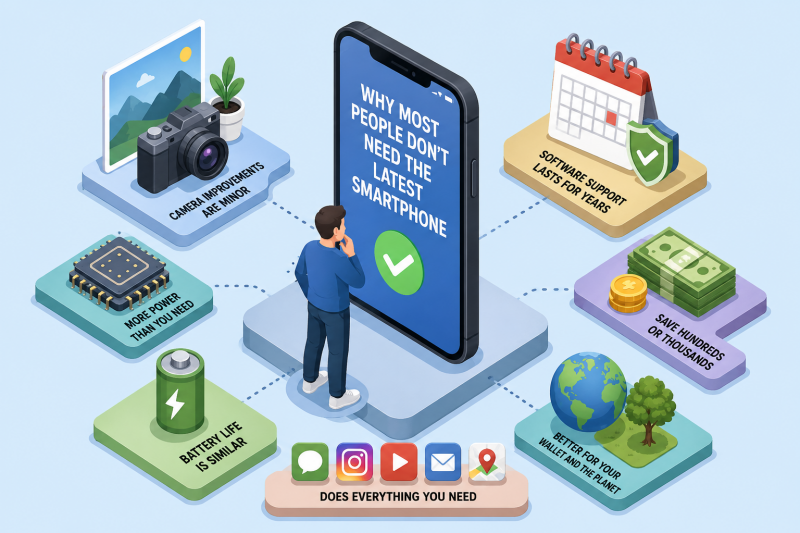
That may sound surprising, especially when the marketing suggests otherwise. But the truth is that smartphone technology has reached a point where most consumers already own devices that are far more capable than they actually need.
This doesn’t mean new smartphones are bad products. Far from it. Today’s flagship devices are engineering marvels. The issue is that manufacturers are solving problems that most users don’t actually have.
If you’re considering spending $1,000, $1,200, or even $1,500 on the latest smartphone, it may be worth asking yourself a simple question first:
What exactly is wrong with the phone you already own?
For many people, the honest answer is “not much.”
Smartphones Have Become Victims of Their Own Success
The smartphone industry faces an unusual challenge.
The products have become so good that there is little reason to replace them frequently.
Think back to the early days of smartphones.
A device released in 2010 felt ancient by 2013. Screens improved dramatically. Cameras improved dramatically. Battery life improved dramatically. Internet speeds improved dramatically.
Upgrading every two years made perfect sense because each new generation offered major improvements.
Today, the differences are far less dramatic.
Modern smartphones already offer:
- Stunning displays
- Fast internet connections
- Excellent cameras
- Reliable battery life
- Secure biometric authentication
- Powerful processors
- Large storage capacities
In many cases, a smartphone released three or four years ago still performs everyday tasks with ease.
That’s a remarkable achievement for the industry.
Unfortunately for manufacturers, it’s also a business problem.
Most People Use Their Phone for the Same Five Things
Let’s be honest about how most people use their phones.
The average day looks something like this:
| Activity | Typical Usage |
|---|---|
| Texting and messaging | Multiple times per day |
| Social media | Frequent |
| Frequent | |
| Streaming video | Frequent |
| Web browsing | Frequent |
That’s about it.
Some people use navigation apps. Some take photos. Some play games.
But for the majority of users, their smartphone serves as a communication and entertainment device.
None of those activities require cutting-edge hardware.
If your phone can open Instagram, stream Netflix, send emails, and browse the internet without frustration, the latest processor probably isn’t going to transform your experience.
Many consumers are paying premium prices for performance they never actually use.
Smartphone Marketing Is Designed to Create Dissatisfaction
One of the most successful tricks in modern marketing is convincing people that a perfectly good product is suddenly inadequate.
Every smartphone launch follows a familiar formula.
The company presents a list of improvements compared to last year’s model:
- Camera quality improved by 12%
- Processing speed improved by 18%
- Battery efficiency improved by 8%
- Screen brightness improved by 15%
These numbers sound impressive.
The problem is that most people never notice them.
If your current phone already takes excellent photos, how much does a slightly better photo matter?
If apps already load instantly, does making them load 0.2 seconds faster improve your life?
Marketing focuses on specifications because specifications are measurable. Real-world benefits are often much harder to demonstrate.
The result is that consumers become excited about improvements they may never actually experience.
The Camera Race Has Reached a Point of Diminishing Returns
For years, smartphone cameras have been the industry’s primary selling point.
Every new launch claims to offer professional-quality photography.
And to be fair, modern smartphone cameras are genuinely incredible.
The problem is that they were already incredible several years ago.
Most photos people take end up:
- On Instagram
- On Facebook
- In text messages
- In cloud storage
- On laptop screens
They are rarely printed at large sizes.
They are rarely viewed under professional conditions.
In those everyday situations, the difference between a photo taken on a three-year-old flagship phone and a brand-new flagship phone is often extremely difficult to spot.
Professional photographers may appreciate the improvements.
Most consumers won’t.
That’s not because the upgrades aren’t real.
It’s because the improvements have become increasingly small.
Faster Processors Solve Problems That Don’t Exist
Every year brings another processor breakthrough.
Manufacturers proudly announce:
- More cores
- Better graphics
- Faster AI processing
- Improved efficiency
From an engineering perspective, these achievements are impressive.
From a consumer perspective, they are often irrelevant.
Most smartphone users aren’t editing Hollywood movies on their phones.
They aren’t rendering complex 3D graphics.
They aren’t running demanding scientific simulations.
They’re sending texts.
They’re scrolling through social media.
They’re watching videos.
Modern processors are already so fast that many common tasks feel instantaneous.
When something already feels instant, making it even faster becomes difficult to appreciate.
The Price of Flagship Phones Has Become Hard to Justify
Smartphone prices have risen dramatically over the past decade.
A premium flagship phone today often costs:
| Category | Typical Price |
| Premium Flagship | $1,000–$1,700 |
| Mid-Range Smartphone | $300–$700 |
| Refurbished Flagship | $350–$800 |
At some point, consumers need to ask whether the improvements justify the expense.
For many households, spending over $1,000 on a phone means sacrificing other opportunities.
That same money could be used for:
- Building an emergency fund
- Paying down debt
- Taking a vacation
- Investing for retirement
- Home improvements
- Family experiences
The latest smartphone may be exciting.
But excitement doesn’t automatically make it a good financial decision.
Mid-Range Phones Have Become Surprisingly Good
This is perhaps the biggest reason most people don’t need a flagship device.
Mid-range smartphones have improved enormously.
A $500 phone today often includes:
- Excellent cameras
- Long battery life
- Fast charging
- High-quality displays
- 5G connectivity
- Smooth performance
For everyday users, the experience is remarkably close to that of a premium flagship.
The difference between a $500 phone and a $1,500 phone is frequently much smaller than the difference in price would suggest.
This is a classic example of diminishing returns.
You pay significantly more money for increasingly modest improvements.
Software Support Lasts Longer Than Ever
One of the strongest arguments for frequent upgrades used to be software support.
That argument is becoming weaker every year.
Major manufacturers now provide long-term support for their devices.
Many smartphones receive:
- Security updates for years
- Operating system upgrades for years
- Continued app compatibility for years
This means a well-maintained phone can remain useful for much longer than consumers traditionally expected.
The idea that every smartphone becomes obsolete after two years simply isn’t true anymore.
Artificial Intelligence Is Being Used as the New Sales Pitch
The latest trend in smartphone marketing is artificial intelligence.
Manufacturers now advertise AI features for:
- Writing assistance
- Image editing
- Voice transcription
- Search tools
- Productivity tasks
Some of these features are genuinely useful.
Many are not.
The challenge is that smartphone companies need a new reason to convince consumers to upgrade.
Artificial intelligence has become the newest selling point.
The problem is that many people are still figuring out whether these features meaningfully improve their daily lives.
For many consumers, they don’t.
At least not yet.
The Environmental Cost Is Often Ignored
Every smartphone requires raw materials, manufacturing, transportation, and energy.
Mining the materials needed for electronics carries environmental consequences.
Manufacturing devices consumes resources.
Shipping products around the world generates emissions.
When consumers replace perfectly functional phones every year or two, those environmental costs increase unnecessarily.
Research from the European Environment Agency has highlighted how extending the lifespan of electronic devices can significantly reduce their environmental impact.
Keeping a phone for an additional year or two may not feel dramatic, but collectively it can make a meaningful difference.
Social Pressure Plays a Bigger Role Than Most People Admit
Many upgrades are not driven by necessity.
They’re driven by psychology.
Humans naturally compare themselves with others.
When friends upgrade, coworkers upgrade, or influencers showcase the latest devices, it creates subtle pressure to do the same.
Smartphones have become status symbols.
Owning the newest model can feel like a sign of success, modernity, or technological sophistication.
There is nothing wrong with enjoying technology.
There is nothing wrong with wanting a new phone.
The important distinction is understanding the difference between wanting something and needing something.
Many consumers confuse the two.
When You Actually Should Upgrade
There are situations where upgrading makes perfect sense.
Consider replacing your phone if:
- The battery no longer lasts through the day.
- The manufacturer has stopped providing security updates.
- Essential apps no longer work properly.
- The device has significant physical damage.
- Performance issues interfere with daily use.
- Repair costs exceed replacement costs.
These are practical reasons to upgrade.
Buying a new phone because your current phone genuinely limits you is very different from buying one because an advertisement convinced you that last year’s model is suddenly outdated.
The Best Smartphone for Most People
This may not be what smartphone manufacturers want to hear, but for most consumers the best smartphone is often not the newest one.
It’s the phone that:
- Meets your needs
- Fits your budget
- Remains secure
- Performs reliably
- Doesn’t create financial stress
That might be a current flagship.
It might be a mid-range device.
It might even be the phone already sitting in your pocket.
The answer depends on your circumstances, not on a marketing campaign.
Final Thoughts
The smartphone industry has done such a good job of innovating that it has created a strange situation: most people already own technology that exceeds their everyday needs.
Modern smartphones are powerful, capable, reliable, and packed with features. For many users, a device that is two, three, or even four years old can still provide an excellent experience.
That doesn’t mean new phones aren’t impressive.
They absolutely are.
But impressive and necessary are not the same thing.
Before upgrading, ask yourself whether the latest smartphone will genuinely improve your life or simply give you a slightly newer version of something you already have.
For most people, the answer is surprisingly clear.
You probably don’t need the latest smartphone.